

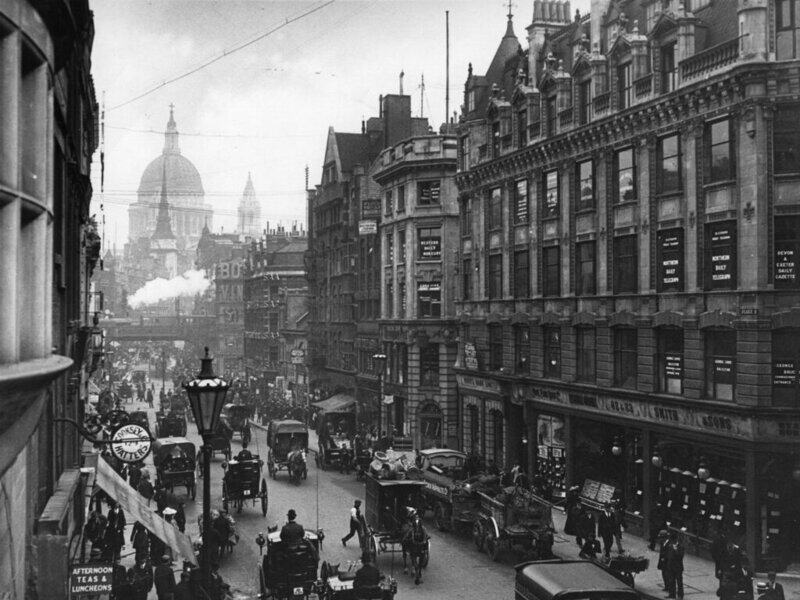
Before Charles Dickens became one of the most widely read novelists of the nineteenth century, he learned to observe London as a working journalist. The streets around Fleet Street introduced him to the rhythms of newspapers, courts, Parliament, printers and crowded urban life. They also helped form the sharp social awareness that would later define novels such as Oliver Twist, David Copperfield and Bleak House.
To understand Charles Dickens and Fleet Street is therefore to look beyond literary biography. It is to examine how a particular part of London transformed news into a modern cultural force—and how Dickens turned the city’s noise, movement and inequality into literature.
Fleet Street and the rise of the London press
Fleet Street follows the line of the former River Fleet, which once ran toward the Thames. By Dickens’s lifetime, the stream had disappeared beneath the expanding city, but the street had become firmly associated with printing and journalism. Its position between the City of London and Westminster made it a natural route for political news, commercial information and public debate.
The newspaper industry was not confined to one building or one profession. Reporters, editors, compositors, printers, illustrators and news sellers all contributed to the rapid production of the daily press. Improved printing technology, growing literacy and expanding urban populations created an appetite for information. Newspapers could now influence public opinion on government, poverty, crime and reform.
For a young writer, Fleet Street offered a practical education in how London communicated with itself. It was a place where private stories became public issues and where political decisions could be translated into readable, marketable news.
How Dickens entered journalism
Born in 1812, Dickens had an unusually varied early working life. His family’s financial difficulties and his father’s imprisonment for debt left a lasting impression on him. Those experiences sharpened his awareness of insecurity, humiliation and the institutions that shaped ordinary lives.
In the early 1830s, he taught himself shorthand and began working as a reporter. He reported proceedings in Parliament and the courts, first for newspapers including the True Sun and later for the Morning Chronicle. Parliamentary reporting demanded speed, concentration and accuracy. It also required a talent for reconstructing spoken language in a form that readers could follow.
This work trained Dickens to listen closely. He encountered politicians, lawyers, witnesses and campaigners, while observing how formal language could conceal human motives. The discipline of reporting gave him an extensive working knowledge of dialogue, gesture and public performance—skills that became central to his fiction.
From shorthand to literary voice
Dickens’s journalism did more than provide employment. It shaped the distinctive energy of his prose. His writing often moves rapidly between voices, scenes and social levels, much as a reporter moves through a busy city gathering impressions. He noticed accents, clothing, habits and physical details, then arranged them into memorable portraits.
His first published sketches appeared under the pen name Boz, beginning in the 1830s. These pieces captured London through short scenes of daily life: transport, shopping, entertainment, work and social encounters. The city was not merely a backdrop. It was an active presence, filled with systems and institutions that could protect people, ignore them or trap them.
That perspective became one of Dickens’s greatest literary strengths. He could make a bureaucratic office, a school, a prison or a courtroom feel dramatically important because he understood how such places affected real lives. His comic exaggeration and vivid characterisation were joined to the reporter’s instinct for social detail.
London as a character
Many of Dickens’s novels are structured around movement through London. Characters cross bridges, enter courts, pass through alleys and travel between prosperous districts and areas marked by poverty. The geography reveals relationships of power. A change of street can mean a change of social status, opportunity or danger.
In Oliver Twist, London becomes a landscape of hunger, crime and institutional indifference. Bleak House turns the legal world into a vast system whose delays spread confusion through society. In Little Dorrit, debt and bureaucracy shape both family life and national administration. These works are fictional, but their force depends on Dickens’s close attention to the real structures of Victorian Britain.
Fleet Street belonged to this wider urban network. It connected the world of print with the legal institutions around the Inns of Court, the political centre at Westminster and the commercial heart of the City. Its cultural importance came not from a single landmark, but from the concentration of professions and information along its route.
Why Dickens still matters to the history of journalism
The relationship between Dickens and journalism also belongs to a larger history of mass communication. Newspapers helped create a shared public conversation in which events could reach readers far beyond the places where they occurred. Dickens understood the emotional power of that expanding audience and became an important participant in it.
He continued to write journalism throughout his career, editing periodicals such as Household Words and All the Year Round. These publications combined fiction, reportage, commentary and practical subjects. Their success showed how Victorian readers moved fluidly between news and storytelling.
Dickens’s achievement was to bring the immediacy of journalism into the novel without reducing fiction to simple reporting. He gave social observation a memorable cast of characters, dramatic plots and a language capable of both satire and sympathy. Fleet Street helped teach him where stories came from: not only from grand events, but from the daily pressures experienced by ordinary people.
Exploring Dickens and Fleet Street with WVT
The connection between Dickens’s early career and London’s newspaper district can be explored further through the World Virtual Tours event LIVE WALK in LONDON: Charles Dickens on Fleet Street. Guided by Nick, this live walk examines the places Dickens worked and walked, as well as locations associated with his literary world. The format offers an opportunity to connect the history of journalism, the streets of London and the development of one of Britain’s major novelists in a shared, guided exploration.

Meet your World Virtual Tours guide: Nick.
Explore the upcoming tour: LIVE WALK in LONDON: Charles Dickens on Fleet Street


