

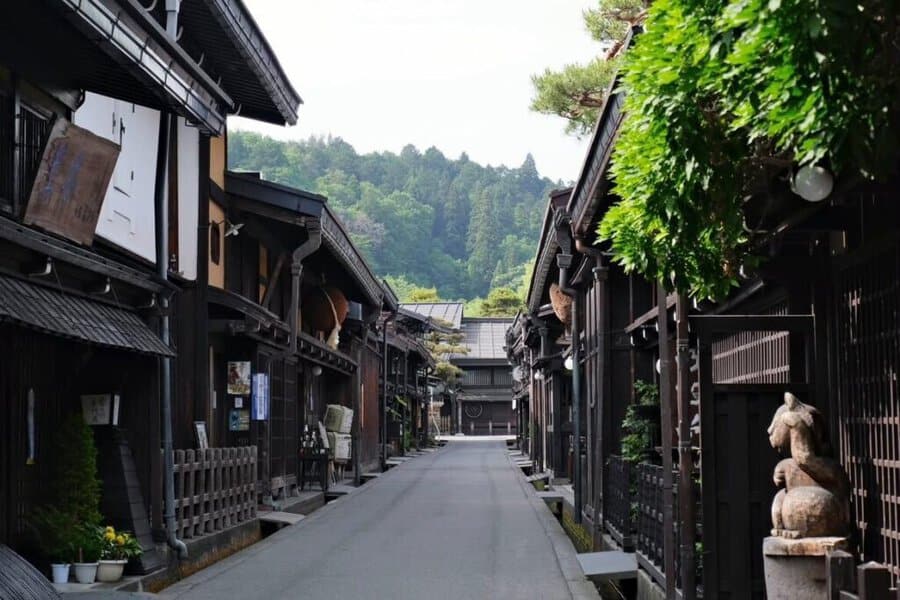
In the mountains of central Japan, Takayama offers a different view of the country’s urban history. Rather than being defined by skyscrapers or major imperial monuments, the city reveals its past through narrow streets, wooden façades, family-run shops and markets that still serve local residents. To understand Takayama Japan is to look closely at how geography, commerce and craftsmanship shaped a community over centuries.
Located in the Hida region of Gifu Prefecture, Takayama developed in a relatively secluded mountain basin. Its distance from Japan’s great political centres helped preserve a distinct local identity, while its forests and skilled artisans gave the town an important economic role. The result is a place where historic architecture is not isolated from daily life: it remains part of the streetscape, the food culture and the rhythm of the morning.
Why Takayama developed its own identity
Hida was known for its abundant timber and for the expertise of its woodworkers. During the early modern period, the Tokugawa shogunate valued the region’s forests and controlled them closely. Hida craftsmen were also respected for their building skills and were employed in major construction projects elsewhere in Japan. This connection between local resources and specialist labour helped shape Takayama’s reputation as a town of artisans.
The mountain environment influenced more than architecture. Travel was difficult, and agricultural land was more limited than in Japan’s broad plains. Communities therefore relied on forestry, craftsmanship, trade and carefully developed local food traditions. These conditions encouraged a strong sense of regional character, visible today in Hida’s wooden houses, fermented products and distinctive forms of domestic design.
The historic centre and the language of wooden architecture
The best-known part of the Takayama old town is its network of streets lined with dark timber buildings. Many date from the Edo period, when Takayama became an important local administrative and commercial centre. The façades are restrained but highly functional, combining shops, workshops and residences in compact urban plots.
Several details reveal the social and economic life of the town. Deep wooden fronts protected interiors from the weather, while sliding doors and carefully proportioned openings allowed buildings to adapt to different uses. Traditional merchant houses often included narrow shop areas facing the street and more private spaces behind them. Some also contained small gardens or courtyards, creating a gradual transition between public commerce and domestic life.
Darkened wood, tiled roofs and orderly façades give the historic streets a unified appearance, but the buildings are not identical. Their differences reflect the owners’ occupations, wealth and practical needs. Looking at these variations is a reminder that historic towns are not museum sets: they are records of ordinary work, trade and family life.
Morning markets and the culture of local exchange
Takayama’s morning markets are among the clearest expressions of this living urban tradition. Markets have long connected producers from the surrounding countryside with people in the town. Seasonal vegetables, pickles, fruit, flowers and regional specialities reflect the agricultural calendar and the foodways of the Hida area.
The markets also offer a different perspective on heritage. Historic buildings tell us how people lived and worked in the past, while market activity shows how local exchange continues in the present. The emphasis is not only on purchasing goods, but also on conversation, familiarity and the circulation of knowledge about ingredients and preparation.
Local food traditions are closely tied to the region’s geography. Hida cuisine makes use of mountain produce, preserved foods and cattle raised in the area. Products such as miso, pickles and seasonal vegetables demonstrate how communities adapted to climate and distance from major supply centres. In this sense, a market visit can reveal as much about regional history as a monument can.
Craftsmanship, festivals and collective memory
Takayama’s cultural identity is also expressed through its craftsmanship. Woodworking remains central to the image of the Hida region, while lacquerware, furniture and other artisanal practices connect contemporary makers with older skills. These traditions are not frozen in one historical period; they change as materials, markets and lifestyles change.
The city is particularly associated with the Takayama Festival, held in spring and autumn. Its elaborate floats, known as yatai, demonstrate the technical and artistic resources of the historic community. Carved decoration, mechanical details and textile work reflect the investment that local neighbourhoods made in public celebrations. The festival therefore functions not only as a spectacle, but also as a form of collective memory and civic organization.
Even outside festival days, the streets preserve traces of this communal culture. Shrines, merchant houses, workshops and food businesses occupy a shared environment in which history is encountered through movement rather than only through display. The town’s heritage is strongest when architecture, craft and everyday activity are considered together.
How to read Takayama beyond the postcard image
Visitors often first notice Takayama’s visual coherence, but its deeper story lies in the relationship between the town and its surrounding landscape. Forests supplied materials; mountain roads shaped trade; climate influenced preservation and building methods; and regional isolation encouraged distinctive customs. Each street can therefore be read as part of a larger system connecting urban life with the Hida countryside.
This perspective also helps explain why Takayama remains culturally significant. Preservation is not simply about keeping old façades intact. It involves maintaining knowledge, food practices, local businesses and forms of social interaction that give those façades meaning. The town’s past survives because it continues to be used, adapted and discussed.
Exploring Takayama with World Virtual Tours
The atmosphere and history of Takayama Japan are especially rewarding when viewed at street level, where architectural details and everyday activity can be considered together. The World Virtual Tours event LIVE WALK in JAPAN: Discovering Traditional Takayama offers an opportunity to explore the morning market and historic streets through a live online walk with guide Patrizia B. and local guide Eriko. The format extends the story beyond photographs, inviting viewers to observe local traditions and specialities in context while discovering the character of this mountain town.
Meet your World Virtual Tours guide: PatriziaB.
Explore the upcoming tour: LIVE WALK in JAPAN: Discovering Traditional Takayama


