

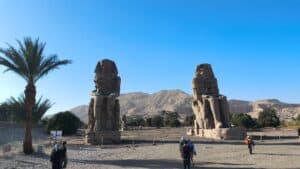
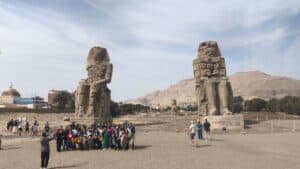
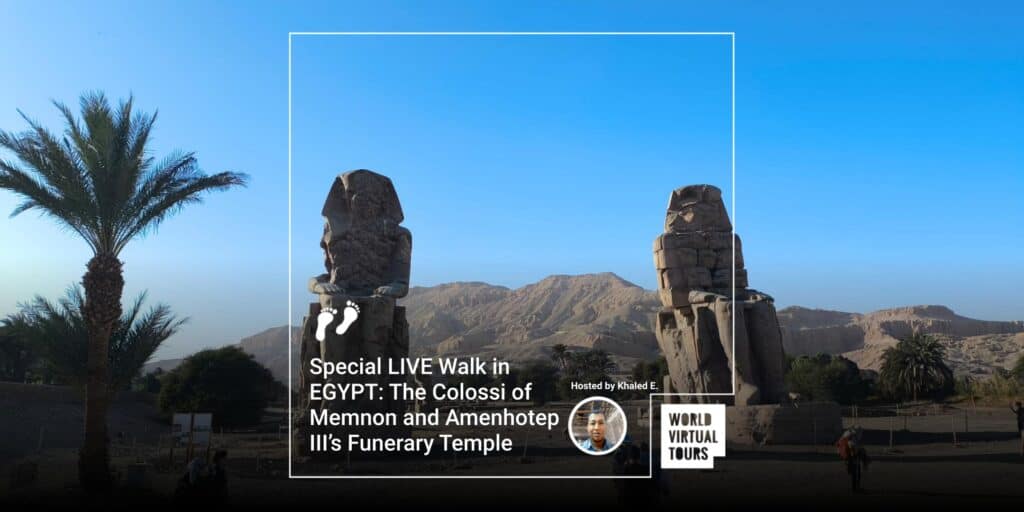
Rising majestically on the West Bank of Luxor, the Colossi of Memnon have watched over the Nile Valley for more than 3,400 years. These colossal statues are among the most iconic monuments of Ancient Egypt, standing as silent witnesses to the grandeur of the reign of Pharaoh Amenhotep III, one of the most powerful rulers of the New Kingdom.
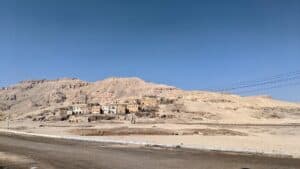
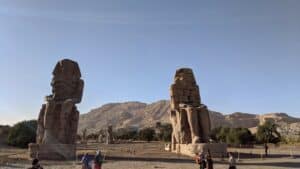
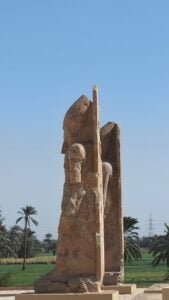
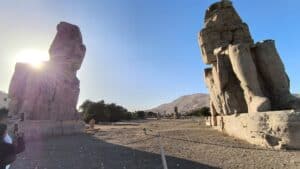
But these towering figures were never meant to stand alone. They once formed the monumental entrance to one of the largest temple complexes ever built in Egypt: the Funerary Temple of Amenhotep III.
The Legacy of Pharaoh Amenhotep III 👑
Amenhotep III ruled Egypt during the 18th Dynasty (around 1390–1352 BCE), a period of remarkable prosperity and artistic achievement. His reign is often considered a golden age of Egyptian civilization, marked by monumental building projects and flourishing cultural life.
The pharaoh commissioned temples, statues, and palaces throughout Egypt, but his most ambitious project was his Funerary Temple in Thebes, constructed on the west bank of the Nile near modern-day Luxor. This vast complex was designed to honor the king’s divine status both during his life and after his death.
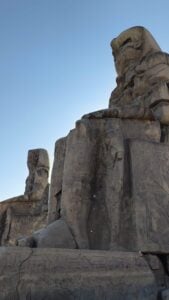
At its entrance stood two colossal statues depicting the pharaoh seated on his throne — the famous Colossi of Memnon.
The Colossi of Memnon 🗿
Each statue stands approximately 18 meters (60 feet) tall and weighs an estimated 720 tons. Carved from quartzite sandstone blocks transported from quarries near modern Cairo, these giants represent Amenhotep III as a divine ruler gazing toward the rising sun.
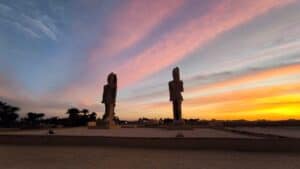
Despite earthquakes and centuries of erosion, the statues still dominate the landscape today. Visitors traveling through the Theban Necropolis often encounter them at sunrise, when their massive silhouettes glow against the desert horizon.
The “Singing Statue” Mystery 🎶
One of the most intriguing legends associated with the Colossi dates back to the Roman period. After an earthquake in 27 BCE damaged the northern statue, travelers reported hearing mysterious sounds at dawn — described as a musical note or whispering voice.
Ancient visitors believed the statue was “singing”, greeting the rising sun or mourning its broken state. Roman emperors and travelers journeyed from across the Mediterranean to witness the phenomenon.
Modern scholars believe the sound was likely caused by temperature changes and moisture evaporating within cracks in the stone, but the legend of the “Vocal Memnon” became one of the earliest recorded tourist attractions in history.
The Lost Temple of Amenhotep III 🏛️
Behind the statues once stretched the immense Funerary Temple of Amenhotep III, believed to have been the largest temple complex in Egypt at the time.
The temple covered more than 35 hectares, filled with colossal statues, courtyards, and sanctuaries dedicated to the cult of the king and the gods.
Over the centuries, however, flooding from the Nile and the reuse of stone for later constructions caused most of the temple to collapse or disappear. Archaeological excavations in recent decades have revealed fragments of statues, foundations, and monumental sculptures that hint at its former splendor.
Today, the site is one of the most fascinating ongoing archaeological projects in Egypt.
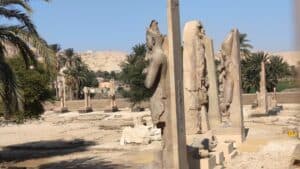
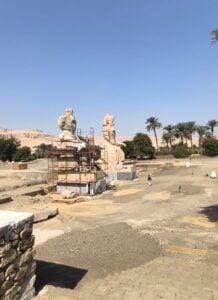
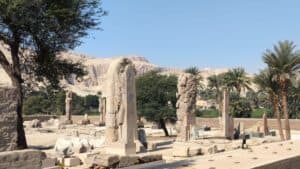
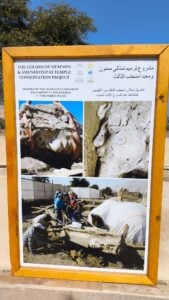
Recent Archaeological Discoveries at Amenhotep III’s Temple
The site of Amenhotep III’s Funerary Temple is not only a window into the past — it is also one of the most exciting ongoing archaeological projects in Egypt today.
In December 2025, archaeologists unveiled two massive restored alabaster statues of King Amenhotep III at their original location near the Third Pylon of the temple at Kom El-Hetan, on the West Bank of Luxor.
These colossal statues, measuring approximately 13.6 and 14.5 meters in height, depict the pharaoh seated on his throne. The sculptures were carefully reconstructed from thousands of fragments, a meticulous effort carried out by the Egyptian-German archaeological mission working on the site.
The restoration project, led for decades by archaeologist Dr. Hourig Sourouzian, aims to gradually reconstruct what was once known in antiquity as the “Temple of Millions of Years” of Amenhotep III — one of the largest temple complexes ever built in Ancient Egypt.
Alongside the restored statues, excavations have also revealed sphinx statues, monumental sculptures, and numerous statues of the goddess Sekhmet, offering new insights into the extraordinary scale and religious significance of the temple.
Each discovery helps scholars better understand how this immense complex once looked when it dominated the landscape of ancient Thebes.
Walking Through Ancient Thebes 🌄
Standing between the Colossi and the ruins of the temple offers a powerful glimpse into the scale of ancient Egyptian architecture. Surrounded by the dramatic landscape of the Theban West Bank, visitors can imagine the processions, rituals, and ceremonies that once animated this sacred space.
It is here that the desert, the Nile, and thousands of years of history meet — a place where the legacy of the pharaohs still feels alive.
Join Us for a Special LIVE Walk in Luxor 🇪🇬
To truly understand the scale and atmosphere of this extraordinary archaeological site, nothing compares to experiencing it live.
On March 29, World Virtual Tours will host a special event:
👉 Special LIVE Walk in EGYPT: The Colossi of Memnon and Amenhotep III’s Funerary Temple
This unique live experience will take you directly to the West Bank of Luxor, where you will explore the monumental statues, the archaeological remains of the temple, and the fascinating discoveries that are still emerging from the sands today.
The tour will be led by Khaled, the beloved Egyptian guide of World Virtual Tours, returning after more than a year since his last live event for another extraordinary walk directly from Luxor.
It will be a rare opportunity to see one of the most impressive archaeological sites in Ancient Egypt while learning from a guide who knows the land, the history, and the hidden stories of the Nile Valley.ies behind one of Egypt’s most impressive ancient sites.
🔗 Reserve your place here:
https://www.worldvirtualtours.online/events/special-live-walk-in-egypt-the-colossi-of-memnon-and-amenhotep-iiis-funerary-temple
#ColossiOfMemnon #AmenhotepIII #AncientEgypt #Luxor #EgyptianHistory #WorldVirtualTours #ThebanNecropolis #Egyptology #Archaeology #EgyptTravel #HistoryLovers #LiveWalk #AncientCivilizations #DiscoverEgypt #HistoricalMysteries


 ENSURE you DID IT in the previous step

 and
get the Zoom Link directly
and
get the Zoom Link directly 

