

Rome is often presented through its ancient monuments, Renaissance churches and grand historic avenues. But Pasolini in Rome begins somewhere else: among dusty roads, informal settlements, markets, apartment blocks and expanding suburbs at the edge of the city. For Pier Paolo Pasolini, these places were not merely neglected spaces beyond the postcard. They were where postwar Rome revealed its deepest social changes.
Pasolini arrived in Rome in the early 1950s and encountered a city undergoing rapid transformation. Migration, poverty, new housing developments and the expansion of the urban perimeter were changing everyday life. In the working-class districts and borgate—peripheral neighborhoods often built with limited infrastructure—he found the settings, voices and conflicts that would define much of his Roman writing and filmmaking.
Pasolini in Rome: seeing beyond the historic center
The Rome of monuments had long been celebrated by artists, travelers and filmmakers. Pasolini did not ignore that Rome, but his attention moved decisively toward the places that conventional representations left out. He was interested in the city as lived by people who had little connection to its official image: laborers, migrants, street vendors, unemployed young men and families living on the urban margins.
This perspective changed the meaning of the city itself. Rome was no longer only an inheritance from antiquity or a stage for elegant urban life. It became a fragmented landscape in which different communities experienced radically different versions of the same capital. The center and the outskirts were physically connected, yet socially divided.
What were the Roman borgate?
The word borgata can refer broadly to a peripheral settlement or outer neighborhood. In postwar Rome, the term became associated with areas shaped by rapid population growth, limited public services and uneven development. Some were informal or semi-rural in character; others consisted of newly built housing estates separated from the historic city by empty land, roads and construction zones.
These neighborhoods were not static. Their residents developed strong forms of community, local speech and cultural identity, even while facing economic hardship. Pasolini recognized that the outskirts possessed their own social codes and forms of dignity. He also understood that modernization could be disorienting: older ways of life were disappearing, while consumer culture and new urban habits were spreading across the city.
For this reason, the borgate in Pasolini’s work are more than backgrounds. They are active forces. Streets, courtyards, vacant lots and peripheral roads shape how characters move, speak and imagine their futures.
From Ragazzi di vita to Accattone
Pasolini’s Roman novel Ragazzi di vita brought the world of marginal neighborhoods and young men into literature with unusual directness. Its language and characters challenged conventional ideas about what belonged in serious Italian writing. Rather than treating the urban poor as picturesque figures, Pasolini presented them as complex individuals navigating friendship, survival, desire and violence.
He carried this approach into cinema with Accattone, his first feature film as a director. The film’s Roman outskirts are stark and exposed, marked by unfinished construction, open land and precarious housing. Its visual language refuses the polished image of the capital. The city appears harsh, but it is also intensely human, filled with gestures, rivalries and fragile relationships.
Mamma Roma and the contradictions of modernization
In Mamma Roma, the outskirts again become central, but the focus shifts toward aspiration and social mobility. The title character hopes to build a more secure life for herself and her son, yet the new apartment blocks and modernizing city do not automatically provide freedom. Architecture promises progress, while social inequality continues beneath the surface.
This tension is one of the defining themes of Pasolini’s Rome. New suburbs could represent opportunity, displacement or exclusion, depending on who inhabited them. The rapidly changing city was not simply moving from poverty to prosperity. It was reorganizing its inequalities, often pushing vulnerable communities farther from the historic center.
Why Pasolini’s Rome still matters
Pasolini’s work remains relevant because the questions he asked are not limited to his own period. Who has the right to be visible in a city? Which neighborhoods are represented, and which are ignored? What happens when redevelopment changes a community faster than its residents can adapt?
Rome’s outskirts have continued to change since Pasolini’s time. Some areas have gained services and recognition; others still experience isolation and economic pressure. Yet his films and books provide a way to read the city historically. They encourage us to look at roads, housing estates and peripheral landscapes not as empty spaces, but as evidence of migration, policy, memory and everyday life.
Exploring Pasolini’s Rome with World Virtual Tours
The hidden geography of Pasolini’s Rome is the subject of the World Virtual Tours event “PASOLINI IN ROME: The City You Never See.” In this online VideoWalk, guide Alba, an archaeologist and licensed Rome tour guide, connects Pasolini’s literature and films with the neighborhoods, people and urban transformations behind them.
The experience begins at Casa Pasolini in Rome’s Rebibbia district, the museum located in the apartment where Pasolini lived during his first years in the city. Through photographs, maps, archival material and film footage, the event offers a deeper way to consider the Rome beyond its celebrated monuments. Learn more through the World Virtual Tours event page.
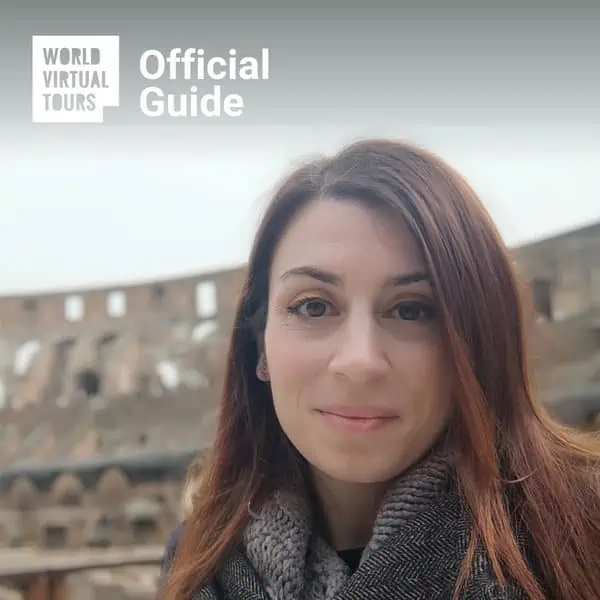
Meet your World Virtual Tours guide: Alba.
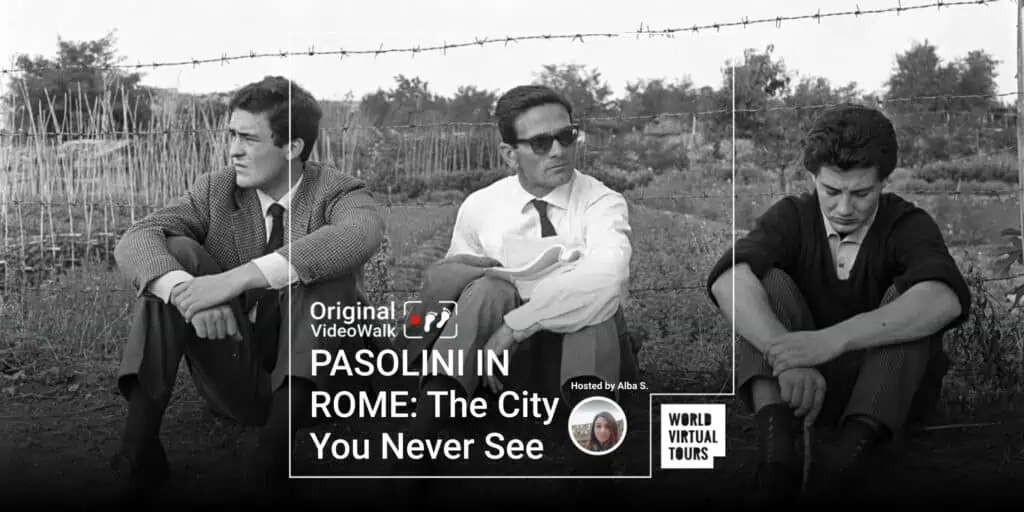
Explore the upcoming tour: PASOLINI IN ROME: The City You Never See


